The February Free Press Second Saturday Salon held on February 14 by Zoom was hosted by Free Press Board member Mark Stansbery and featured a talk and Powerpoint by local activist Tom Dillard.
Watch salon video here
Tom Dillard presented a historical overview of two major civil rights movements in Columbus: the Vanguard League and Congress of Racial Equality (CORE). He shared personal stories and experiences from his family's involvement in the Vanguard League, which was founded in 1940 to address discrimination in public accommodations, employment, housing, and education. Dillard highlighted key moments in the organization's history, including protests against segregation in theaters and housing restrictions, and emphasized the ongoing relevance of their work today.
He described the Harlem Renaissance's influence and how the integration of Black soldiers and workers into the community, following Executive Order 9981, led to significant changes in housing and employment opportunities. Tom highlighted the efforts of the Vanguard League in confronting discrimination, including legal actions and direct actions like picketing, and their collaboration with other organizations like CORE. He emphasized the importance of policy changes in advancing civil rights and the ongoing struggle against educational segregation.
Historical Activism and Quaker Influence
The group discussed historical events and connections, particularly focusing on Stanley Robinson and his work, as well as the Quaker movement's influence on nonviolent activism. Tom shared personal experiences about his family's involvement with the Robinsons and the Quaker community, while Mark Stansbery and Bob Roehm explored the historical significance of CORE and its impact in Ohio. The conversation highlighted the importance of understanding historical movements and their ongoing relevance, with Tom emphasizing the spiritual and symbolic nature of recent peace walks.
Civil Rights Movement Organizing Strategies
Tom shared personal experiences including his involvement in protests against segregation at the Crystal Swimming Club pool in South End. The group also talked about a protest at a roller rink on the city's east side, attended by Free Press Senior Editor Harvey Wasserman and where journalist Amos Lynch was arrested. Mark provided additional context about the location of the segregated swimming pool, which was near Oakwood.
Tom described how communities were organized around various issues, including employment and housing, through tactics like sending Black individuals to apply for jobs that were denied to them and then sending in a white person with less credentials who would get the job. The discussion highlighted the strategic approach of organizing communities rather than just addressing individual issues, which Tom attributed to the work of organizations like Model Cities.
Columbus CORE: Civil Rights History
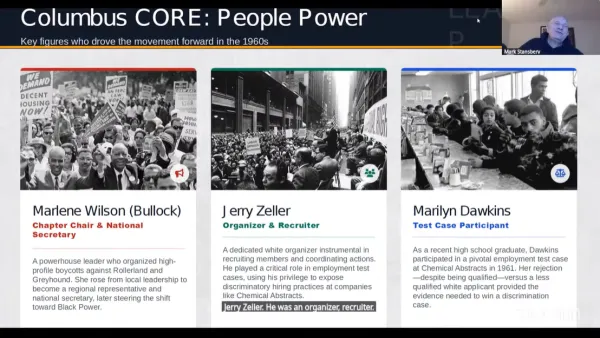
Tom presented a historical overview of CORE's efforts in the 1960s, including the Freedom Motorcade and comprehensive demands for community development. He highlighted the connection between these movements and the War on Poverty, emphasizing the importance of addressing multiple issues simultaneously. The presentation concluded with a reading of key figures involved in these efforts. Mark suggested a parenthetical discussion about CMACAO, a community action organization, but time constraints prevented a full exploration of that topic.
Technocracy and Tyranny Discussion
The meeting focused on discussing the impact of technocracy and tyranny, particularly in the context of post-9/11 policies like the Patriot Act. Mike Zarzano raised concerns about current societal issues, comparing them to historical struggles for civil rights. The group discussed potential strategies for organizing against these challenges, with Tim suggesting the creation of short historical stories to be shared on WGRN.
Dialogue Across Political Divides
The group discussed the importance of dialogue and understanding different perspectives, particularly between those with opposing political views. Tom shared his experiences with interfaith and intergroup discussions, emphasizing the value of open conversations. Mark and others agreed on the need to reach out to those with differing views, with Jaime suggesting a "we are their salvation" approach. The group explored ideas for facilitating these conversations, including potential meet-ups for pizza and discussions at the YMCA.
Debating Strategies and State Crimes
The group discussed strategies for engaging in debates with opponents who are often described as "afraid" and "incapable of debate." Nevin emphasized that these opponents prefer simple answers and often use deflective tactics. Mike proposed a collaborative effort among diverse groups to address state crimes, including JFK, RFK, MLK, COVID, 9/11, and Epstein files. Tom suggested focusing on personal values and beliefs rather than relying on external sources or crutches like political parties. The group also discussed the importance of documenting government overreach and excessive power while working within the legal system to address these issues.
Political Divisions and Education Needs
The group discussed political divisions and the need for education, particularly comparing the current Republican voter rights bill to John Lewis' voting rights legislation. Tom shared his personal experience of losing a friendship due to political differences, expressing a desire to understand how such divisions arise. Mike reported on splits within the MAGA movement, particularly regarding Gaza and electoral representation issues, while Tim noted that people may be becoming more aware of how money in politics corrupts the system.
Leadership, Advertising, and Social Issues
The group discussed various topics including the importance of focusing on policy rather than personality in leadership, and the role of nonviolence in social movements. Tom shared a story about the Tar Baby to illustrate the dangers of getting involved in conflicts with others. The group also touched on issues related to ICE and the need for documentation of police actions. Mark announced that the next salon would be held on March 14th and would focus on issues facing journalists.